FRP Outdoor Planters for Commercial Landscapes: Design, Durability and Specification Guide
The planter is one of those elements on a commercial project that nobody thinks about until something goes wrong. A cracked pot on a rooftop garden. A rusted metal container staining the pavement underneath it. A heavy stone planter that the structural engineer flagged as a load concern three weeks before handover. These are avoidable problems — and most of them come down to a material decision made too quickly.
FRP planters have become a serious specification choice for commercial landscape projects across India precisely because they address all of these problems at once. Not because they are the most glamorous material on the market — but because they work reliably in situations where other materials create complications.
At DECO we manufacture FRP outdoor planters for commercial landscapes, hospitality developments, corporate campuses and public spaces across India. This guide covers what you need to know about FRP planters from a design, durability and specification standpoint — so you can make the right call for your next project.
What Are FRP Planters and Why Are They Different?
FRP stands for Fibre Reinforced Polymer. The material is formed by combining glass fibres with a polymer resin — producing something that is rigid, strong and almost completely impervious to moisture, corrosion and chemical damage. The manufacturing process allows complex shapes to be produced consistently and at scale.
What makes fiberglass planters different from traditional planter materials is the combination of properties they offer together. Light weight. High strength. Corrosion resistance. Design flexibility. Low maintenance. No single traditional material — stone, precast concrete, terracotta, metal — offers all of these at once. FRP does.
DECO FRP planters are manufactured with wall sections thick enough to handle soil load, water weight and root pressure under full planting conditions — while remaining significantly lighter than any equivalent stone or concrete planter. That combination is what makes them particularly well suited to commercial landscape applications where structural load, installation efficiency and long term performance all matter.
Where FRP Planters Perform Best on Commercial Projects
Understanding where fiberglass planters genuinely outperform other materials helps narrow down the specification decision quickly. These are the situations where DECO FRP outdoor planters consistently deliver the best project outcomes.
Rooftop and Podium Level Landscapes
This is where the weight advantage of FRP planters has the most direct financial impact. Rooftop gardens and podium level landscapes sit on structural slabs with defined load capacity. Every kilogram of planter, soil and plant counts toward that capacity. DECO FRP planters weigh a fraction of equivalent stone or concrete planters — freeing up structural load capacity for more planting, more furniture or simply allowing a less intensive slab design from the start.
On large commercial podium projects with dozens or hundreds of planters, switching from stone to DECO FRP planters can reduce the cumulative dead load significantly — translating into real structural cost savings.
Coastal and High Humidity Locations
Salt air is aggressive. It corrodes metal, degrades painted surfaces and accelerates the weathering of many materials that perform fine inland. FRP is inherently corrosion resistant — the material itself does not react to salt, moisture or the chemical exposure that coastal environments create.
For commercial projects in Mumbai, Chennai, Kochi, Goa and other coastal locations across India, DECO FRP planters maintain their appearance and structural integrity without the corrosion maintenance that metal planters require or the staining that affects stone in salt air conditions.
Indoor Atriums and Interior Landscape
Interior landscape installations — hotel lobbies, corporate atrium gardens, retail environments, airport terminals — place specific demands on planters. Floor load limits, no tolerance for leakage or staining, the need for planters to be repositioned as layouts evolve. FRP planters handle all of these conditions naturally. They are light enough to move. They do not leak if properly manufactured. And their surface does not stain the flooring underneath.
Large Format Commercial Landscaping
When a commercial project requires a large number of planters across an extensive landscape area — corporate parks, resort gardens, mixed use development podiums — FRP is the most practical material at scale. Consistent manufacturing quality, reasonable lead times, manageable installation without heavy equipment and a surface finish that holds up over time without significant maintenance.
Design Considerations for FRP Outdoor Planters
Working with an experienced FRP planter manufacturer at the design stage makes a significant difference to the outcome — both in terms of the visual result and the practical performance of the installation.
Form and Profile
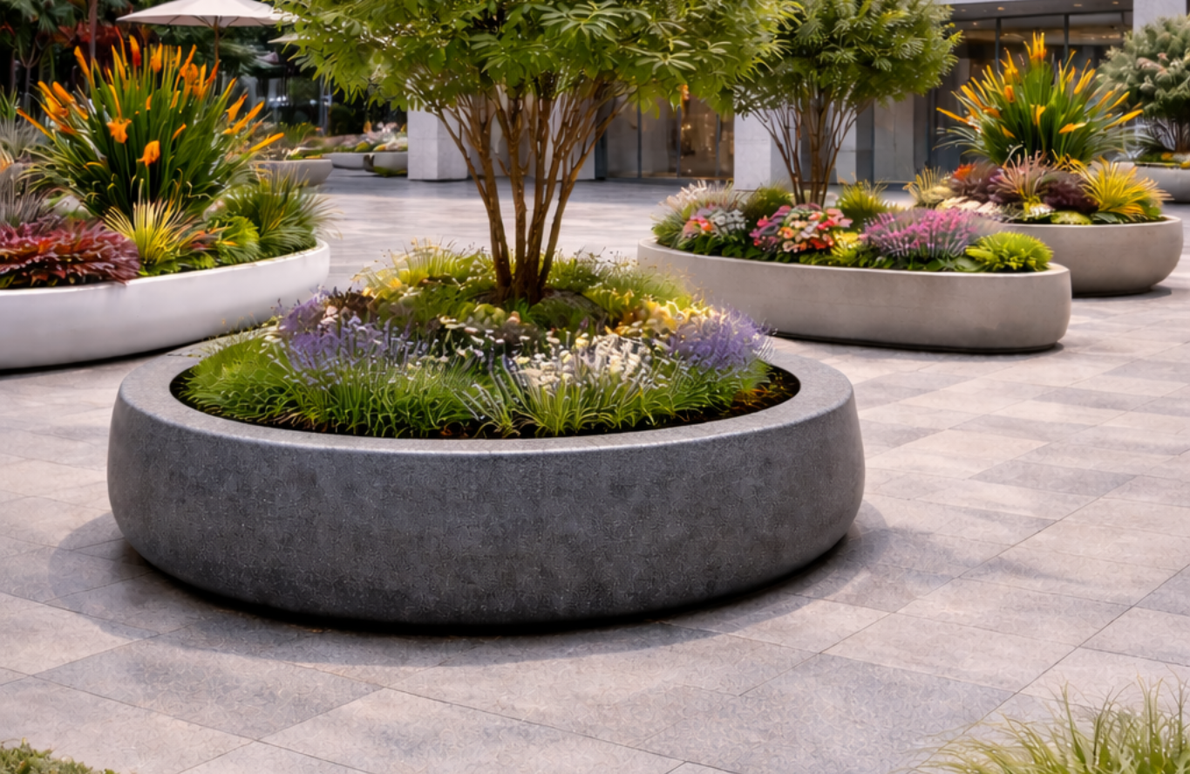
FRP can be manufactured in almost any planter form — rectangular, circular, tapered, organic, custom profile. The casting process does not impose the geometric limitations that stone cutting or metal fabrication does. DECO works with landscape architects and architects to develop planter forms that carry the design language of the project — whether that is minimal and geometric or more expressive and sculptural.
Wall Thickness and Structural Specification
Wall thickness for DECO FRP outdoor planters is specified based on planter dimensions, planting depth requirements and installation context. Larger planters with deeper planting profiles need thicker walls to handle the soil and water load without flexing. DECO's manufacturing team calculates the right specification for each planter size and application — ensuring structural performance is built in from the start rather than assumed.
Drainage Design
Proper drainage is critical for any planted container. DECO FRP planters are manufactured with drainage provisions — either pre-formed drainage holes or drainage inserts — specified to suit the planting design. For planters on waterproofed surfaces, drainage connection details are coordinated with the landscape and waterproofing design to prevent water pooling on the slab.
Surface Finish and Color
DECO FRP outdoor planters are available in a range of surface finishes — smooth, lightly textured, stone effect and custom colors. The finish is applied during manufacturing and is UV stable for exterior applications. Custom color matching to a project's material palette is available for larger orders — allowing the planters to integrate cleanly with the overall landscape and architectural design.
Specification tip: Always confirm UV stability of the surface finish for exterior FRP planter applications. A finish that is not UV stabilised will fade and chalk within one to two seasons of outdoor exposure in Indian sun conditions.
Durability and Long Term Maintenance
One of the most consistent pieces of feedback from developers and facilities managers who have specified DECO FRP planters is that the maintenance requirements are significantly lower than they expected — especially compared to their previous experience with metal or stone planters.
FRP does not rust. It does not crack under normal thermal cycling. It does not absorb moisture and the surface does not support biological growth in the way that porous stone or concrete does. Routine maintenance for DECO FRP outdoor planters is essentially periodic cleaning — no sealing treatments, no rust prevention, no joint repointing.
Over a ten or fifteen year commercial landscape lifespan, the cumulative maintenance cost difference between FRP and alternative materials is substantial. This is increasingly a factor in specification decisions at the developer level — particularly on large projects where maintenance budgets are planned years in advance.
A Note on GRC and UHPC Planters
DECO also manufactures planters in GRC and UHPC for projects where design complexity, premium surface quality or specific structural requirements point toward those materials. GRC planters offer excellent sculptural flexibility. UHPC planters deliver the highest surface quality and long term durability for premium applications.
For projects where light weight, corrosion resistance, installation efficiency and value at scale are the primary drivers — FRP outdoor planters are the right specification. DECO's full planter range covers all three materials and the right choice is always determined by the specific project situation.
Frequently Asked Questions
Q1. What is the weight advantage of DECO FRP planters over stone or concrete planters?
DECO FRP outdoor planters are significantly lighter than equivalent stone or precast concrete planters — typically 60 to 75 percent lighter for the same planter volume. This weight advantage directly reduces structural dead load on rooftop and podium applications and makes installation faster and easier without heavy lifting equipment.
Q2. Are DECO fiberglass planters suitable for outdoor use in Indian climate conditions?
Yes. DECO FRP planters are manufactured for Indian outdoor conditions including monsoon rainfall, high UV exposure, high humidity and coastal salt air. The material is inherently corrosion resistant and UV stabilised surface finishes are available for exterior applications to prevent fading and surface degradation over time.
Q3. Can DECO manufacture FRP planters in custom shapes and sizes?
Yes. DECO manufactures FRP outdoor planters in fully custom dimensions, profiles and surface finishes. Rectangular, circular, tapered, organic and bespoke custom forms are all achievable. Custom color matching is available for larger project orders. DECO works with landscape architects and designers to develop planter specifications that suit the project's design intent and structural requirements.
Q4. How long do DECO FRP outdoor planters last in commercial landscape applications?
DECO FRP outdoor planters have a lifespan of 15 to 20 years or more in commercial landscape applications when properly specified and maintained. The material does not rust, crack under normal conditions or require periodic sealing or surface treatment — making long term maintenance simple and cost effective compared to metal or stone alternatives.