GRC vs UHPC vs FRP: Which Material Is Right for Your Elevation?
A great elevation begins with a simple question: what should the façade be made of?
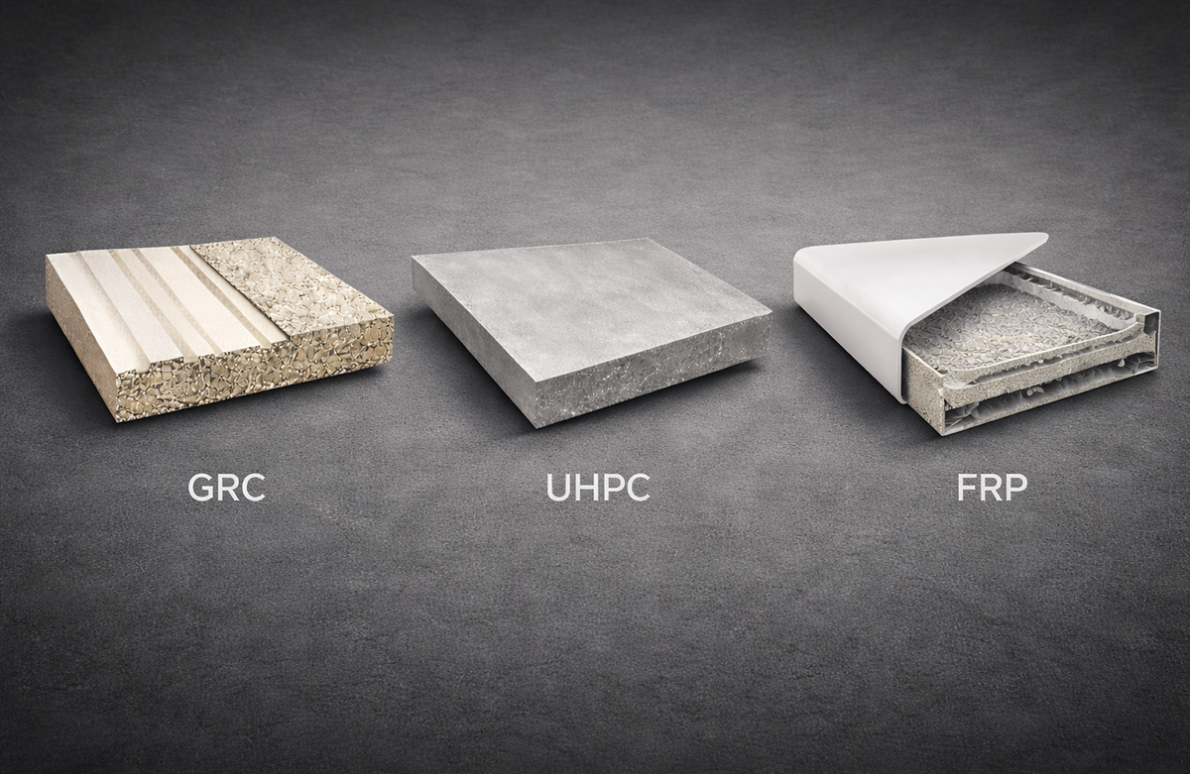
At DECO, we work with GRC, UHPC, and FRP because each material has a distinct architectural personality-defined by weight, durability, detailing sharpness, installation speed, and cost logic.
This guide helps you select the right material for your elevation with clarity.
Quick Snapshot: What Each Material “Feels” Like in Architecture
GRC (Glass Reinforced Concrete): sculptural, stone-like, versatile-ideal for rich design language and custom moulded forms.
UHPC (Ultra High Performance Concrete): precision and permanence-ultra-slim, crisp edges, high resistance in harsh or high-abuse zones.
FRP (Fibre Reinforced Plastic): lightweight and fast-excellent for retrofits, fast execution, and complex forms where weight is the constraint.
Compare What Matters on Real Projects
1) Design freedom & geometry
GRC: excellent for fluting, ribs, cornices, frames, deep textures, and repeatable decorative modules.
UHPC: best for sharpness-thin fins, crisp grooves, razor lines, premium minimal geometry.
FRP: strongest for complex curves and lightweight 3D forms-especially when speed and handling matter.
Choose:
- want a stone-like architectural language → GRC
- want razor-edge refinement and thin profiles → UHPC
- want curves + fast installation + low weight → FRP
2) Weight & structural impact
FRP is typically the lightest option, easing load on existing structures and reducing lifting complexity.
GRC sits in the middle-lighter than traditional precast while retaining mineral authenticity.
UHPC can be thin, which reduces weight-but the system still requires engineered fixings and careful handling.
Choose:
- retrofit / limited structural capacity → FRP
- new build with strong design expression → GRC
- thin premium elements, high durability needs → UHPC
3) Durability & site conditions
UHPC excels in abrasion/impact zones (plinths, public edges, corners).
GRC performs strongly outdoors when joints, drainage, and curing are handled correctly.
FRP resists corrosion and is valuable in coastal projects-when UV stability and movement detailing are correctly specified.
Choose:
- public/high-traffic or long-life premium elevations → UHPC
- standard exterior façade with good detailing discipline → GRC
- coastal + lightweight + speed priorities → FRP
4) Installation speed & project timelines
FRP is the most “timeline-friendly” due to low weight and easier handling.
GRC is efficient when modularized and supported by a clean substructure.
UHPC requires precise engineering and handling-often used selectively for signature zones.
5) Budget logic (the practical truth)
GRC: best cost-to-design ratio for expressive façades.
FRP: cost-effective when site time is expensive and weight constraints drive the decision.
UHPC: premium-best used where it reduces thickness, elevates aesthetics, and reduces maintenance risk.
A Simple Decision Framework (Use This on Every Elevation)
Use GRC when:
- you want architectural richness (flutes, ribs, mouldings, textured panels)
- you need modular cladding with strong design identity
Use UHPC when:
- you need ultra-slim panels/fins
- sharp grooves and edges define the architecture
- high-abuse zones demand long-term toughness
Use FRP when:
- retrofit conditions and weight limitations exist
- speed and handling are priorities
- complex curves or lightweight screens are required
The Best Elevations Use a Hybrid Strategy
Many premium projects use:
- UHPC at the plinth + corners (impact and crispness)
- GRC across the main façade field (design freedom and value)
- FRP for lightweight features or retrofit areas (speed and low load)
CTA:
Share your elevation grid and site conditions-DECO can recommend a hybrid material strategy with module sizes, fixing intent, and finish direction.