GRC Jali for Building Façades: Privacy Without Blocking Light and Air
Privacy is one of the most important requirements in modern buildings.Residential balconies need privacy from neighbouring towers. Hotels need guest room privacy without making the façade look closed. Commercial buildings need screening for service areas, staircases, and semi-open zones. Malls and mixed-use developments need visual separation without losing openness.
But privacy should not always mean solid walls.
A solid wall may block visibility, but it also blocks natural light, airflow, and visual depth. It can make a façade look heavy, closed, and flat.
This is where GRC jali for building façades becomes an intelligent architectural solution.
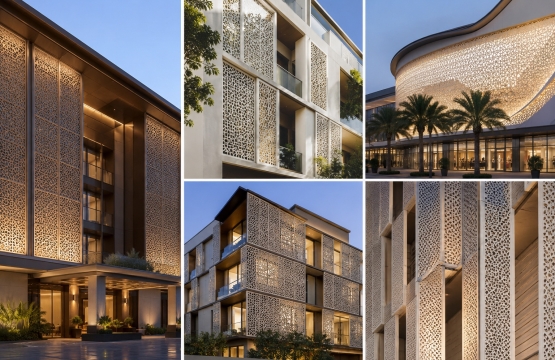
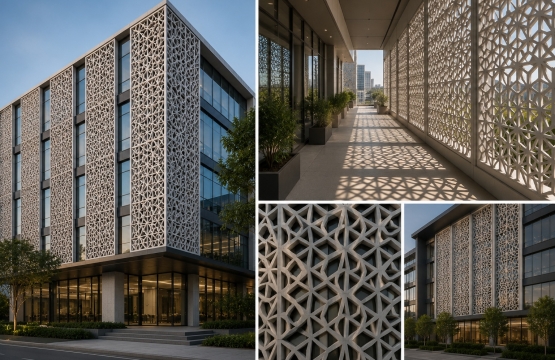
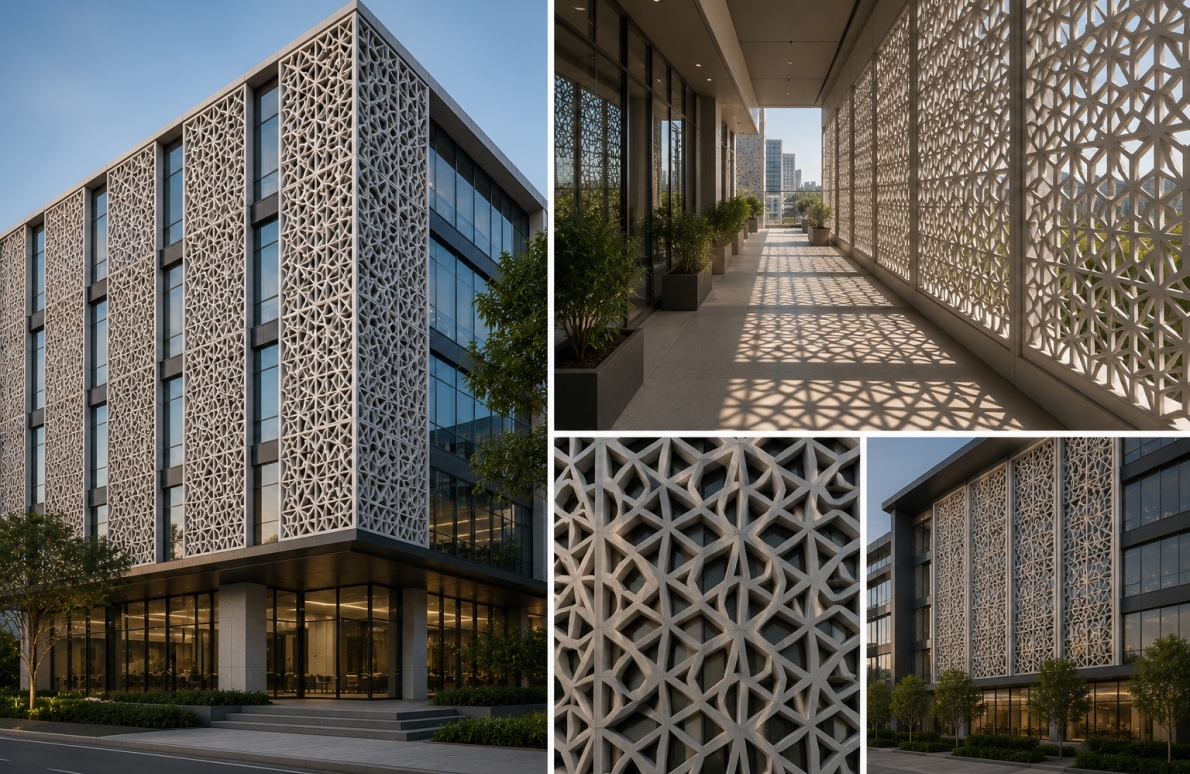
A GRC jali screen creates privacy while still allowing light and air to pass through. It provides a controlled layer between the inside and outside. It filters views, softens sunlight, creates shadow patterns, and adds a strong design identity to the building elevation.
For architects and developers, GRC jalis offer a practical way to balance privacy, comfort, and façade expression.
What Is a GRC Jali?
A GRC jali is a perforated architectural screen made using Glass Reinforced Concrete. It can be designed in different patterns, sizes, thicknesses, and finishes depending on the project requirement.
The openings in the jali allow light and air to pass through, while the solid portions create privacy and shading. This makes it suitable for both functional and decorative façade applications.
Common Applications of GRC Jalis
GRC jalis are commonly used in:
- Residential balconies
- Hotel room façades
- Commercial building elevations
- Parking façades
- Podium screens
- Staircase screening
- Terrace privacy walls
- Courtyard partitions
- Mall façades
- Service area screens
- Entrance feature walls
- Landscape partitions
Unlike ordinary grills or temporary screens, GRC jalis are architectural elements. They are designed to become part of the building language.
Why Privacy Matters in Modern Façade Design
Urban buildings are becoming closer to each other. Residential towers face neighbouring balconies. Hotel rooms face public roads or internal courtyards. Commercial buildings have service zones that need to be hidden. Amenity areas need openness but also separation.
In such conditions, façade privacy becomes important.
However, privacy must be handled carefully.
If the solution is too closed, the building may feel dark and heavy. If the solution is too open, the space may feel exposed. A jali provides the middle ground.
It allows the building to remain breathable while protecting the space behind it.
This is why GRC jalis are useful for modern façade design. They provide privacy without removing the qualities that make a space comfortable — light, air, and openness.
Privacy Without Solid Walls
The main advantage of a GRC jali is that it creates visual screening without complete enclosure.
A solid wall separates.
A glass surface exposes.
A jali filters.
This filtering quality is valuable in modern architecture. It allows people inside the building to feel protected without feeling disconnected from the outside. It also helps the façade maintain a lighter and more elegant appearance.
For example, a balcony with a solid wall may feel enclosed. A balcony with a standard railing may feel too exposed. A GRC jali screen creates a better balance. It gives residents privacy while still allowing daylight and air.
In hotels, jalis can provide privacy for guest balconies or room-facing corridors.In commercial buildings, they can screen functional areas without making the elevation look blank.In malls, they can conceal service or parking areas while maintaining airflow.
Light Control with GRC Jali Screens
Natural light is important in any building, but uncontrolled sunlight can create glare and heat. GRC jalis help manage light more thoughtfully.
The pattern of the jali breaks direct sunlight into softer filtered light. This reduces the harshness of sunlight and creates beautiful shadow patterns across floors, walls, and internal surfaces.
The level of light control depends on the jali design.A dense pattern allows less direct light and provides more privacy. A larger opening pattern allows more daylight and visibility. The depth and thickness of the jali also affect the shadow quality.
This gives architects the ability to design jalis based on the function of the space.
For residential balconies, the jali may need a balanced opening ratio for light and privacy.For a hotel façade, the pattern may be denser for guest comfort.For a mall or commercial façade, a bold large-scale pattern may be used to create visual impact while still providing shade.
Airflow and Ventilation Benefits
A common problem with solid screening is that it blocks airflow. This can make semi-open areas feel stuffy and uncomfortable.GRC jalis solve this problem by allowing air movement through the screen.
They are useful for spaces such as:
- Balconies
- Parking façades
- Semi-open corridors
- Staircases
- Service areas
- Podium levels
- Terrace partitions
- Courtyard edges
In parking structures, airflow is essential. A GRC jali can screen the parking area visually while still allowing ventilation.In residential buildings, balcony jalis allow fresh air without exposing the space completely.In hotels, they can make outdoor and semi-open areas feel private yet breathable.This balance of air and privacy is one of the strongest reasons to use jalis in façade design.
Improving Building Elevation Design
A GRC jali does not only solve privacy and airflow issues. It also improves the overall look of the building.
A plain façade may look complete, but it may not feel distinctive. Jalis add pattern, rhythm, and identity. They create shadow, texture, and depth. They can make a building more memorable from the street.
GRC jalis can be designed in different styles, including:
- Geometric patterns
- Traditional motifs
- Parametric patterns
- Linear screens
- Organic designs
- Minimal modern patterns
- Project-specific custom designs
This flexibility allows every project to have a unique façade language.
For developers, this is important because a strong elevation can improve the perception of the project. Buyers, visitors, and clients often judge a property by its exterior appearance.A well-designed jali façade can communicate quality, attention to detail, and architectural intent.
GRC Jali for Residential Buildings
In residential architecture, privacy is a major concern. Balconies, terraces, and windows often face other buildings, streets, or common areas. At the same time, residents want natural light, ventilation, and open views.
GRC jalis are ideal for premium residential façades because they provide privacy without making homes feel closed.
They can be used for:
- Balcony privacy screens
- Terrace partitions
- Podium façade screens
- Clubhouse screens
- Entrance feature walls
- Amenity area partitions
- Staircase screens
- Service area screening
Balcony jalis can also create rhythm across the building elevation. When repeated thoughtfully, they make the façade look organized and premium.
For high-rise residences, jalis can give the building a unique identity while improving the user experience inside each balcony or semi-open area.
GRC Jali for Hotels and Resorts
Hotels require a careful balance between privacy, comfort, and visual appeal. Guest rooms and balconies should feel private, but the building should also look welcoming and premium.
GRC jalis can be used on hotel façades to create a refined hospitality experience.
They can be used for:
- Guest balcony screens
- Room façade privacy
- Courtyard partitions
- Spa area screens
- Outdoor dining zones
- Entrance feature façades
- Service area screening
- Corridor shading
For luxury hotels, jali patterns can be inspired by heritage architecture or local design culture.For modern hotels, clean geometric jalis can create a contemporary identity.
At night, lighting can further enhance the jali pattern, turning the façade into a strong visual feature.
GRC Jali for Commercial Buildings
Commercial buildings often need façades that are professional, efficient, and visually strong. They may also have areas that need privacy or screening, such as staircases, service zones, parking levels, and mechanical areas.
GRC jalis can help commercial façades look more complete and refined.
They can be used for:
- Office façade screens
- Parking level screening
- Staircase enclosures
- Service area concealment
- Podium design
- Entrance walls
- Sun shading elements
- External privacy layers
Instead of leaving functional areas exposed or covering them with blank walls, GRC jalis provide a more architectural solution.They add depth and visual interest while still allowing ventilation where required.
GRC Jali for Malls and Retail Spaces
Malls need strong visual identity. The exterior should attract attention and create recall. At the same time, large retail buildings often include parking areas, service zones, outdoor plazas, and semi-open corridors.
GRC jalis can be used to create bold façade features for malls.
Applications include:
- Main façade screens
- Parking façade jalis
- Entrance portal features
- Outdoor plaza screens
- Food court terrace partitions
- Service area screening
- Decorative elevation panels
A custom jali pattern can help a mall stand out in a busy urban environment. It can also improve the appearance of large surfaces that would otherwise look plain or industrial.
Pattern Selection for Privacy and Light
The success of a jali depends heavily on its pattern. A pattern should not be selected only because it looks attractive. It should also match the purpose of the space.
Important pattern considerations include:
Opening Size
Smaller openings provide more privacy and shade. Larger openings provide more light and visibility.
Pattern Density
Dense patterns are useful for areas requiring high privacy. Open patterns work better for spaces where airflow and visibility are important.
Scale
The pattern must suit the scale of the building. A small detailed pattern may look good up close but may disappear on a large façade. A large bold pattern may work better for malls and commercial buildings.
Orientation
Sun direction affects how much shade is required. West-facing façades may need denser screening than shaded sides.
Visual Style
The pattern should match the project’s architectural language. A luxury residence may need a different design approach than a corporate building or retail project.
Finish Options for GRC Jalis
The finish of a GRC jali has a major impact on the final look of the façade.
Popular finish options include:
- Off-white architectural finish
- Concrete grey finish
- Sandstone texture
- Terracotta tone
- Natural stone finish
- Smooth modern finish
- Pigmented colour finish
- Textured handcrafted finish
For premium residences, neutral or earthy tones often work well.For hotels, warm finishes can create a welcoming look.For commercial buildings, clean grey, white, or custom pigmented finishes may suit the design better.
The finish should coordinate with the façade, glazing, landscape, railings, and other architectural elements.
Jali as a Second Skin Façade
One of the most effective uses of GRC jali is as a second skin façade. In this approach, the jali is installed as an outer layer in front of the main façade.
This creates several benefits:
- Adds depth to the elevation
- Provides privacy
- Filters sunlight
- Creates shadow movement
- Improves façade identity
- Protects semi-open areas
- Allows air movement depending on design
A second skin jali façade can make a building look layered and premium. It also helps the façade respond better to light and climate.
This approach is suitable for hotels, residences, commercial buildings, institutions, and mixed-use developments.
Important Design and Installation Considerations
A GRC jali should be planned carefully from the design stage. Good execution depends on coordination between the architect, façade consultant, structural team, and manufacturer.
Key considerations include:
- Panel size
- Panel thickness
- Fixing system
- Structural support
- Wind load requirements
- Opening ratio
- Pattern scale
- Joint detailing
- Maintenance access
- Finish selection
- Site installation method
A beautiful pattern alone is not enough. The jali must be practical to manufacture, transport, install, and maintain.
This is why project-specific design coordination is important.
Common Mistakes to Avoid
While GRC jalis are highly useful, poor planning can reduce their effectiveness.
Avoid these common mistakes:
- Selecting a pattern without considering privacy needs
- Using very small openings where airflow is required
- Using very large openings where privacy is important
- Ignoring structural and fixing requirements
- Choosing finishes that do not match the building
- Making the façade look too busy with multiple patterns
- Treating the jali as decoration only
A good jali must balance design, function, and construction practicality.
Why Developers Should Consider GRC Jalis
For developers, GRC jalis can add value in several ways.
They help:
- Improve façade identity
- Create a premium building appearance
- Provide privacy for users
- Enhance balcony and semi-open spaces
- Screen service areas
- Create strong visual recall
- Support project differentiation
In competitive real estate and commercial markets, the exterior identity of a building matters.A well-designed GRC jali façade can help the project look more refined, memorable, and marketable.
Why Architects Prefer Custom Jali Design
For architects, custom jali design offers creative freedom. It allows the façade to respond to climate, context, and concept.
Instead of using standard screens, architects can create patterns that reflect the project’s identity. The jali can become part of the overall architectural story.
It can connect with:
- Building geometry
- Landscape design
- Interior themes
- Cultural references
- Brand identity
- Climate strategy
- Material palette
This makes GRC jali a flexible tool for design expression.
Final Thoughts
Privacy is essential in modern buildings, but it should not come at the cost of light, air, and openness.
GRC jalis offer a balanced solution.
They provide screening without heaviness.
They filter sunlight without making spaces dark.
They allow airflow without exposing the space fully.
They add identity without becoming only decorative.
For residential buildings, they improve balcony privacy and elevation design. For hotels, they enhance guest comfort and façade character. For commercial buildings, they screen functional areas while adding architectural value. For malls, they create bold and memorable exteriors.
A GRC jali is more than a patterned panel. It is a façade element that connects privacy, performance, and design.
In modern architecture, façades need to do more than look complete. They need to respond to how people live, work, visit, and experience space.
GRC jalis make that possible.