GRC Planters for Malls and Public Plazas: Designing Spaces People Want to Use
Malls and public plazas are no longer designed only as circulation spaces. They are expected to become destinations. People should be able to walk, pause, sit, interact, take photos, attend events and spend time comfortably. This is why landscape design has become an important part of commercial architecture.
One of the simplest yet most powerful elements in this transformation is the GRC planter.
GRC planters are more than containers for plants. When designed properly, they become architectural tools that define movement, create zones, soften hard surfaces, improve visual appeal and make outdoor spaces more usable. For malls, public plazas, corporate campuses, retail streets and mixed-use developments, GRC planters can help turn open areas into active, attractive and people-friendly environments.
In commercial projects, every outdoor space has a purpose. Entrances must feel welcoming. Walkways must guide movement. Seating areas must feel comfortable. Plazas must remain open yet organized. Greenery must look intentional and well-maintained. GRC planters help bring all these requirements together.
What Are GRC Planters?
GRC planters are architectural planters made using Glass Reinforced Concrete. They are used for outdoor and semi-outdoor landscape applications where durability, design flexibility and premium finishes are important.
Unlike ordinary pots or temporary landscape containers, GRC planters are designed as part of the built environment. They can be customized in shape, size, texture, colour and finish to match the architecture of the project.
GRC planters are commonly used in:
- Mall entrances
- Outdoor plazas
- Retail walkways
- Corporate campuses
- Podium landscapes
- Hotel drop-off areas
- Public seating zones
- Terrace gardens
- Clubhouse landscapes
- Residential developments
- Commercial courtyards
- Institutional outdoor spaces
They can be used as standalone planters, long linear landscape edges, seating-integrated planters, tree planters, divider planters or custom sculptural forms.
Why Malls and Public Plazas Need Better Outdoor Design
In malls and public spaces, the outdoor environment plays a major role in visitor experience. A well designed exterior can increase comfort, improve footfall movement and create a stronger first impression.
Many commercial spaces have large hard surfaces such as paving, glass, concrete, metal and stone. While these materials are functional, they can feel harsh if there is no greenery or spatial softness. Planters help balance this by introducing plants, texture, colour and a human scale.
Public plazas also need clear spatial planning. Without proper design, a large open area can feel empty, confusing or uncomfortable. GRC planters can help organize these spaces without building permanent walls.
They can guide people toward entrances.
They can separate pedestrian areas from vehicle zones.
They can define outdoor seating spaces.
They can create green pockets within hardscapes.
They can make large plazas feel more inviting.
They can support branding and architectural identity.
For malls and commercial developments, this makes planters both functional and aesthetic.
GRC Planters as Space Definers
One of the biggest advantages of GRC planters is their ability to define spaces without closing them.
In public plazas, open space is important. But too much openness can feel unstructured. Planters can create natural boundaries while maintaining visibility and movement.
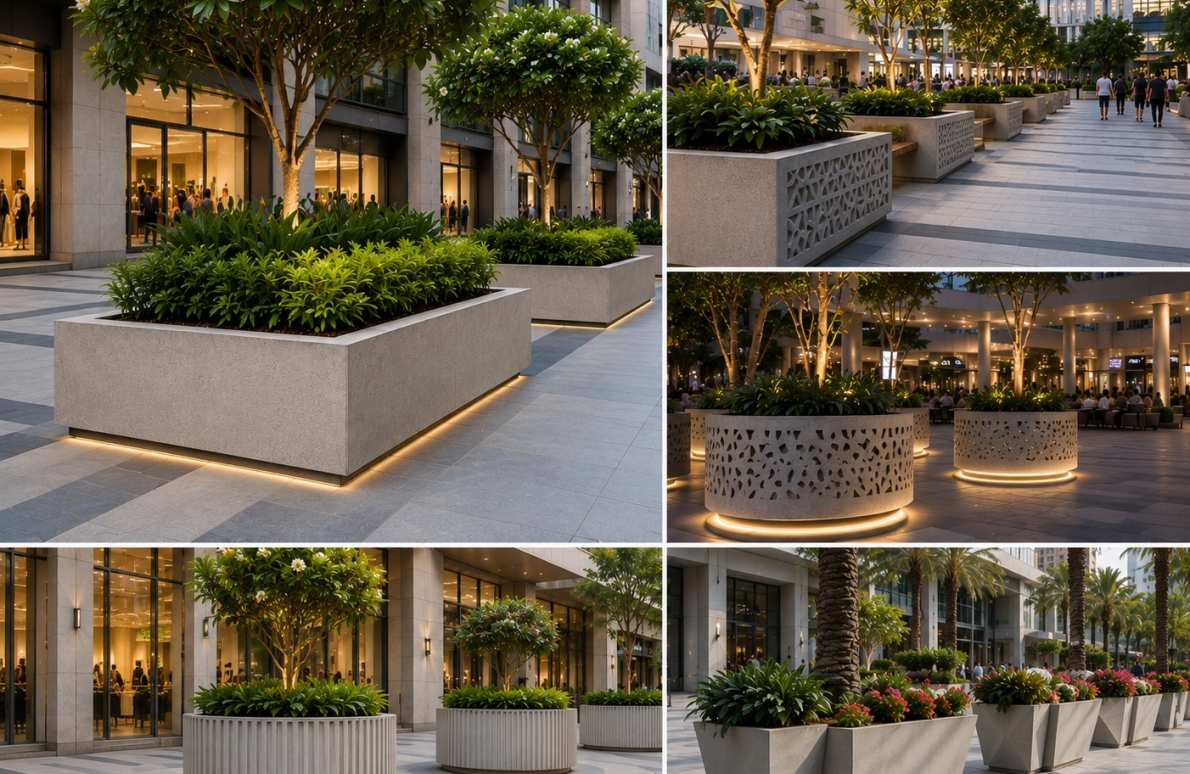
For example, a long rectangular planter can define the edge of a seating zone. A series of large planters can guide visitors toward the mall entrance. Circular planters can create focal points in a plaza. Raised planters can separate walkways from driveways. Low planters can mark zones without blocking the view.
This makes GRC planters ideal for spaces where architects want to create order without using heavy walls or barriers.
Improving Mall Entrances with GRC Planters
The entrance is one of the most important areas of a mall. It creates the first impression for visitors and sets the tone for the entire experience.
GRC planters can make mall entrances feel premium, green and welcoming. Large planters placed near the drop-off area, entrance steps or glass façade can soften the building and create a more inviting arrival.
Entrance planter ideas include:
- Tall planters near the main doorway
- Linear planters along entrance pathways
- Low planters beside seating zones
- Large tree planters for shaded arrival spaces
- Custom planters matching the façade finish
- Planter clusters around signage or branding zones
The goal is not to overcrowd the entrance. The planter design should be clean, balanced and easy to maintain. A few well-placed GRC planters can create a stronger impact than too many random pots.
Designing Public Plazas People Want to Use
A public plaza should not feel like an empty leftover space. It should encourage people to stop, sit and interact.
GRC planters help create more usable plazas by adding structure and comfort. They can be arranged to form outdoor seating zones, shaded corners, green edges and flexible gathering areas.
In plaza design, planters can support:
- Resting spaces
- Informal seating areas
- Pedestrian flow
- Event zones
- Photo-friendly corners
- Green buffers
- Outdoor dining spaces
- Family-friendly areas
When greenery is combined with benches, paving patterns and lighting, the plaza becomes more than a passage. It becomes a place where people want to spend time.
Planters and Outdoor Seating
In malls and plazas, seating is important. People need places to pause, wait, relax and socialize. GRC planters can work very well with outdoor seating design.
Planters can be placed behind benches to create a green backdrop. They can be used as side dividers for seating pods. In some designs, seating can be integrated directly into planter structures.
This is especially useful for high-footfall commercial spaces where furniture must be durable and visually aligned with the architecture.
Planter-integrated seating can be used in:
- Mall outdoor plazas
- Food court outdoor areas
- Corporate campus courtyards
- Retail streets
- Clubhouse landscapes
- Hotel outdoor lounges
- Public waiting zones
The planter provides greenery and spatial definition, while the seating improves usability. Together, they create a complete outdoor experience.
Why GRC Works Well for Commercial Outdoor Planters
Commercial spaces need materials that can handle regular use, outdoor exposure and long-term maintenance requirements. GRC is suitable for such applications because it offers durability and customization.
1. Design Flexibility
GRC can be moulded into different shapes and profiles. This allows architects to create custom planters that match the project’s design language.
Planters can be square, rectangular, circular, curved, tapered, ribbed, faceted, modular or sculptural. This flexibility makes GRC suitable for both modern minimal landscapes and more expressive outdoor designs.
2. Premium Finishes
GRC planters can be developed in multiple finishes such as stone texture, concrete grey, sandstone, terracotta, pigmented tones, smooth surfaces and textured finishes.
This helps planters blend with the façade, paving, wall finishes or overall landscape palette.
3. Durability
Outdoor planters in malls and plazas face sunlight, rain, dust, cleaning activity and public use. GRC planters are designed for exterior applications and can perform well when properly manufactured and installed.
4. Large-Scale Customization
Many commercial projects require large planters that suit the scale of the building. GRC allows the creation of large-format planters that look architectural rather than temporary.
5. Better Visual Integration
Unlike plastic or standard pots, GRC planters can be designed as part of the architecture. They look intentional, permanent and premium.
Types of GRC Planters for Malls and Plazas
Different spaces require different planter types. Choosing the right form is important for both function and visual impact.
Large Rectangular Planters
These are ideal for defining walkways, plaza edges, seating areas and entrance pathways. They create clean lines and organized movement.
Circular Planters
Circular planters work well as focal points in plazas or central open spaces. They can be used around trees or as standalone design features.
Linear Planters
Linear planters are useful for long façades, retail fronts, pedestrian routes and outdoor seating edges.
Modular Planters
Modular planters allow flexible arrangements. They can be repeated across a plaza or rearranged based on site needs.
Tree Planters
Large GRC tree planters can support shaded outdoor spaces and create visual anchors in open areas.
Seating-Integrated Planters
These combine greenery with functional seating and are useful for high-footfall areas.
Custom Sculptural Planters
For premium malls, hotels or public plazas, custom planter forms can become design highlights.
Best Areas to Use GRC Planters in Mall Design
GRC planters can be used across several mall areas.
Entrance Drop-Off Zone
Planters can soften the arrival space and create a premium first impression.
Outdoor Plaza
Planters can define gathering zones, seating areas and pedestrian movement.
Retail Walkways
Linear planters can make walkways more attractive and comfortable.
Food Court Outdoor Areas
Planters can create semi-private dining zones and improve ambience.
Parking Edge
Planters can screen hard edges and improve the transition from parking to entrance.
Signage Areas
Planters can frame brand signage or entrance boards without overpowering them.
Terrace and Podium Areas
Large planters can support rooftop landscapes, podium gardens and amenity zones.
Public Plaza Design Principles Using Planters
To create an effective public plaza, planters should be used with planning and proportion.
Keep Movement Clear
Planters should guide movement, not block it. Pedestrian pathways must remain open and comfortable.
Create Resting Points
Planters can be placed near seating to create shaded and comfortable waiting zones.
Use Scale Carefully
Large plazas need larger planters. Small planters may look lost in big open spaces.
Maintain Visual Balance
Too many planters can make a space look cluttered. A balanced layout creates a stronger impact.
Select Plants Wisely
Plants should suit the local climate, maintenance capacity and available sunlight.
Plan Drainage Properly
Outdoor planters must have correct drainage to avoid water stagnation and surface damage.
Match the Architecture
The planter finish should coordinate with the façade, paving, furniture and landscape design.
Plan for Maintenance
Malls and public spaces require long-term upkeep. Planter placement should allow easy cleaning, watering and plant replacement.
How Planters Improve User Experience
Good outdoor design directly affects how people feel in a space. GRC planters improve the user experience in multiple ways.
They make hard commercial spaces feel softer.
They add greenery and freshness.
They create comfortable pause points.
They help visitors understand movement paths.
They make outdoor seating more attractive.
They improve the visual quality of entrances.
They create photo-friendly spaces.
They make plazas feel more human and welcoming.
In malls, this can encourage visitors to spend more time in outdoor areas. In public plazas, it can make the space feel safer, calmer and more engaging.
GRC Planters and Brand Perception
Commercial buildings are judged by their details. A well-designed planter system can improve the overall perception of a project.
When visitors see clean, durable and well-integrated planters, the space feels more premium. It shows that the developer has invested in design quality and user experience.
For malls, this is especially important. The outdoor environment becomes part of the brand experience. A strong entrance, green plaza and comfortable seating zone can make the property more memorable.
Common Mistakes to Avoid
While planters are effective, poor planning can reduce their impact.
Avoid using too many small pots in large commercial spaces.
Avoid placing planters where they block circulation.
Avoid selecting plants that are difficult to maintain.
Avoid ignoring drainage requirements.
Avoid using finishes that do not match the building.
Avoid random placement without a landscape plan.
Avoid temporary-looking planters in premium projects.
A GRC planter should look like part of the architecture, not an afterthought.
Final Thoughts
GRC planters are powerful design elements for malls and public plazas. They bring greenery, structure, durability and visual quality into outdoor spaces. More importantly, they help create places that people actually want to use.
For malls, planters can improve entrances, walkways, outdoor seating areas and plaza experiences. For public spaces, they can define zones, guide movement and add comfort. For developers, they add long term visual value and improve the overall perception of the project.
A well-designed planter is not just a container for plants. It is an architectural element that shapes how people move, pause and interact with a space.
In modern commercial design, outdoor spaces matter. They influence first impressions, visitor experience and project identity.
With custom GRC planters, malls and public plazas can become greener, more organized and more memorable.